

⏱ Estimated reading time: 2 min read
Charitable giving remains deductible in 2025 and 2026, but who gets the benefit and how much changes, especially beginning in 2026. The rules differ based on whether:
- You itemize or take the standard deduction,
- The gift is cash or property,
- The foundation is public or private, and
- The donor is an individual or a corporation.
Below is a high-level summary followed by examples.

Cash contributions can be made via cash, check, ETF, or credit card. Non-cash contributions generally consist of public or privately traded securities, real estate, vehicles, and tangible personal property. It’s important to note that non-cash contributions > $5,000 require an appraisal.
Example 1 - Individual Itemizer with Cash Contributions
- Filing Status -> Single
- Deduction -> Itemized
- AGI -> $300k
- Cash contributions to public charities -> $30,000

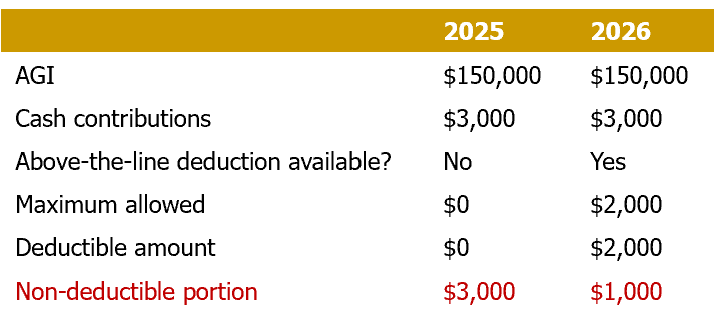
Example 2 - Individual Non-Itemizer with Cash Contributions
- Filing Status -> Married Filing Joint
- Deduction -> Standard
- AGI -> $150k
- Cash contributions to public charities -> $3,000
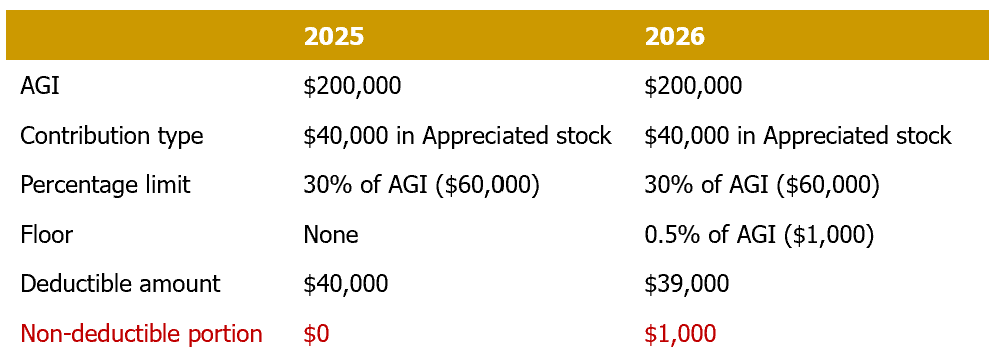
Example 3 - Individual Itemizer with Non-Cash Contributions
- Filing Status -> Married Filing Joint
- Deduction -> Itemized
- AGI -> $200k
- Publicly traded stock to public charities -> $40,000
Example 4 - C Corporation
- Taxable income -> $1,000,000
- Charitable contributions -> $80,000

Conclusion
If you’re unsure whether your contributions will be deductible, need help calculating your allowable deduction, or want assistance organizing the required support (such as contemporaneous receipts, written acknowledgments, or qualified appraisals), it’s worth addressing those issues before filing or even before making the gift.
If you have questions about your charitable contributions or would like help making sure everything is properly documented and reported, feel free to reach out. We’re happy to help you navigate the rules and avoid unpleasant surprises at tax time.
Disclaimer: The information provided herein is intended solely for informational purposes and no person(s) or other third-party may rely upon it as financial, tax, or legal advice or use it for any other purposes. As a result, Royal Financial, and any affiliates, assume no responsibility whatsoever to readers, or any other persons for that matter, as a result of the information contained herein.