
⏱ Estimated reading time: 8 min read
Year-end planning comes down to one idea: recognize income and claim deductions in the year they do the most good.
For 2026, the biggest opportunities for high-income families and business owners sit around a few income thresholds, the limits on itemized and charitable deductions, the rules for expensing business equipment, and the timing of business sales that may qualify for the qualified small business stock (QSBS) exclusion. Here is what to consider before December 31.
Start by projecting your tax rate this year and next. These are the numbers that most often drive year-end decisions:
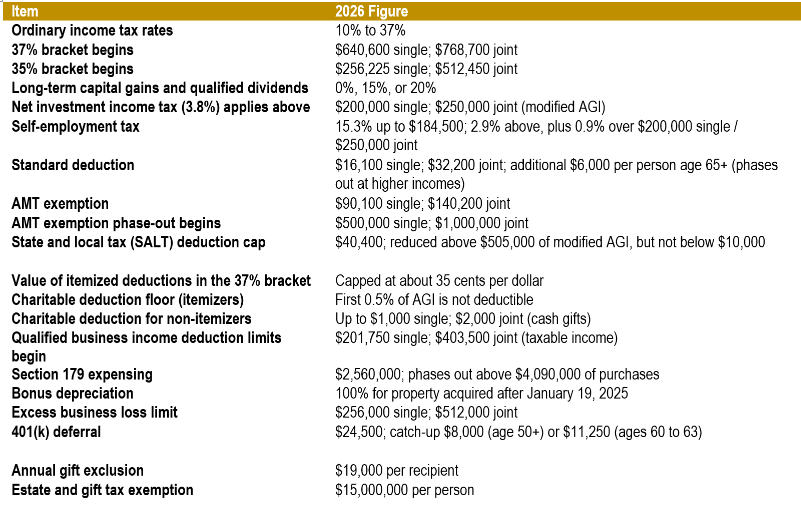
First know how much control you have over timing:
Every strategy below assumes you can shift income or deductions between years. How much room you have depends on your accounting method.
- Cash method. Income is taxed when received and expenses are deducted when paid, so you can time billing, bill payments, and investment sales. Income you could have collected, such as a check you hold until January, is still taxable this year.
- Accrual method. Income is taxed when earned and expenses are deducted when incurred, regardless of when cash moves, so delaying an invoice or prepaying a bill does little. Planning focuses on narrower rules, such as deducting year-end bonuses paid within two and a half months.
- Investments and pass-throughs. Generally control when you sell, but not when interest, dividends, or fund distributions are paid. Partnership and S corporation income is taxed to the owners when the business earns it, whether or not it is distributed.
Strategy 1: Defer income and accelerate deductions
- Your rate is steady or falling. Deferring tax a year is worth the time value of money, and shifting income out of an unusually high-income year can keep it out of the 35% or 37% brackets.
- You are near a threshold. A small cut in AGI can avoid the 3.8% net investment income tax, keep you under the qualified business income limits, or preserve your SALT deduction, which shrinks by 30 cents for every dollar of income above $505,000.
- You own a business. Equipment placed in service by December 31 can be fully expensed. Ordering or paying for it is not enough. Watch the excess business loss limit before creating a large loss.
- You are selling stock in a C corporation. Qualified small business stock (QSBS) held more than five years can exclude gain of up to the greater of $10 million or 10 times your basis. For stock issued after July 4, 2025, the exclusion is 50% at three years, 75% at four, and 100% at five, and the cap rises to the greater of $15 million or 10 times your basis. The 10-times-basis test can be worth far more than the dollar cap if you contributed significant cash or property to the company. If a sale is close to one of these milestones, moving the closing date past it can save more than any other year-end move.
- You can fund retirement plans. Maxing out 401(k) deferrals and employer profit-sharing or cash balance contributions are among the most efficient ways to cut taxable income.
- Your state offers a pass-through entity tax. Electing to pay state tax at the partnership or S corporation level moves that deduction outside the individual SALT cap. About three dozen states offer this election, including Michigan, New York, California, Illinois, and New Jersey. The main exceptions among states with an income tax are Delaware, North Dakota, Pennsylvania, and Vermont. Deadlines vary, and some states, including Michigan and New York, require the election by March 15 of the tax year, so year-end is the time to decide for 2027.
Strategy 2: Accelerate income when it is
Pulling income into this year can lower your lifetime tax bill when:
- You are in AMT this year. Adding income up to the point where regular tax and AMT are equal can mean it is taxed at 26% or 28% rather than a higher regular rate later. This often comes up with incentive stock options (ISOs). When you exercise ISOs and hold the shares, the spread between the exercise price and the stock’s value is not taxed for regular tax but is added to AMT income. Exercising only up to your AMT break-even point each year, or spreading a large exercise over several years, can limit the AMT cost. AMT paid on ISOs generally becomes a credit against regular tax in later years. Plan ISO exercises and QSBS sales together. For QSBS acquired after September 2010, the excluded gain is not added back for AMT, but the taxable portion of the gain still raises AMT income (because starting point for AMT is AGI) and can phase out the AMT exemption, pulling an ISO spread into AMT in the same year.
- You are in a low-income year. Roth conversions or harvesting gains in the 0% or 15% capital gains brackets can fill unused lower brackets.
- You have carryforwards about to expire. Pre-2018 net operating losses, business credits, and charitable carryovers (five years) are lost if unused.
- Higher income is coming. A liquidity event, required minimum distributions, or the scheduled drop in the SALT cap to $10,000 after 2029 may push future rates up.
Strategy 3: Bunched itemized deductions
With a $32,200 standard deduction for joint filers ($16,100 for single filers), many households get little benefit from itemizing every year. Concentrating deductions into one year can change that.
- Charitable gifts. A donor-advised fund (DAF) lets you take several years of deductions now and recommend grants to charities over time. It also limits the bite of the 0.5%-of-AGI floor, which applies each year you give.
- Appreciated stock. Donating long-term appreciated securities avoids capital gains tax and generally provides a deduction for full market value.
- Qualified charitable distributions. At age 70½ or older, giving directly from your IRA keeps the distribution out of income and counts toward required minimum distributions.
- State and local taxes. If you are under the cap, paying your fourth-quarter state estimate or already assessed property taxes by December 31 moves the deduction into 2026.
Strategy 4: Defer deductions that won’t help this year
Prepaying an expense only helps if the deduction actually saves tax (see accounting methods above). Consider waiting when your itemized deductions will fall short of the standard deduction anyway, when AMT will disallow the deduction (as it does for state and local taxes), or when new gifts would crowd out charitable carryovers that are about to expire.
Mind the order of operations
Deductions and limits are applied in a set order, and where an item falls in that order determines how much it is worth. Simplified, the sequence works like this:
- Business losses. Losses must first clear the basis, at-risk, and passive activity rules, then the excess business loss limit. Whatever survives offsets your other income in arriving at AGI.
- Standard or itemized deductions. These come off AGI. Because many floors and phase-outs, including the 0.5% charitable floor and the SALT phase-down, are measured against AGI, reducing AGI in the first step helps twice.
- Qualified business income deduction. QBI comes last and is limited to 20% of taxable income after itemized deductions. Large itemized deductions can shrink the QBI deduction, so a large charitable contribution or year-end state or local tax payment may save a business owner less than expected.
Charitable contributions follow their own ordering rules. Contributions made this year are deducted before any carryovers from prior years, and carryovers expire after five years. A large new contribution in a year when you are already near the AGI limits can push older carryovers past their expiration date, and those prior contributions are lost for good. If you have carryovers, plan new gifts so both can be used.
Your year-end checklist
- Project 2026 and 2027 income, including AMT and the net investment income tax.
- Note how close you are to the thresholds in the table above.
- Confirm your accounting method and how much timing flexibility you have.
- Place business equipment in service by December 31.
- Max out retirement plan contributions.
- Settle your charitable plan: bunching, a donor-advised fund, or IRA distributions.
- Check fourth-quarter estimated payments against the safe harbor.
Let’s talk before December 31
Most of these moves have to be completed by year-end, and the right answer depends on your full picture: income from every source, your business structure, your state, and your plans for next year. Contact us to schedule a year-end planning meeting, and we’ll model the options with you.
Disclaimer: The information provided herein is intended solely for informational purposes and no person(s) or other third-party may rely upon it as financial, tax, or legal advice or use it for any other purposes. As a result, Royal Financial, and any affiliates, assume no responsibility whatsoever to readers, or any other persons for that matter, as a result of the information contained herein.