

⏱ Estimated reading time: 7 min read
When it comes to M&A, tax considerations can play a crucial role in negotiating deal terms. Among the various tax elections available, the §338 election is particularly relevant as it allows certain acquirers in a stock sale to mark up the basis of the assets purchased in exchange for increased cost recovery in future periods.
In this post we will highlight §338 elections, including which entities they apply to, what qualifies as a stock purchase eligible for the election, tax consequences to buyers and sellers, advantages and disadvantages of making the election, deadline to make the election, and how to determine if the election makes sense.
A. The Elections in General
Qualified Stock Purchase (QSP)
A §338 election is available only if the acquirer makes a qualified stock purchase (QSP): one corporation acquires, by purchase, at least 80% of the total voting power and at least 80% of the total value of the target’s stock within a 12-month period. The 80% can be reached in a single purchase or through a series of purchases. Because only a corporation can make a QSP, individuals and partnerships, including most private-equity funds organized as LLCs, generally cannot make a §338 election.
338(h)(1) – 12-month Acquisition Period
The term “12-month acquisition period” means the 12-month period beginning with the date of the first acquisition by purchase of stock included in a qualified stock purchase (or, if any of such stock was acquired in an acquisition which is a purchase by reason of subparagraph (C) of paragraph (3), the date on which the acquiring corporation is first considered under section 318(a) (other than paragraph (4) thereof) as owning stock owned by the corporation from which such acquisition was made).
In plain terms, §338(h)(1) starts the clock: the 12-month acquisition period begins on the date of the first purchase of stock that counts toward the QSP. The acquirer does not have to buy the full 80% in one shot, it can reach the threshold through a series of purchases, as long as it crosses 80% (by vote and value) within 12 months of that first purchase.
338(h)(2) – Acquisition Date
The day the 80% threshold is met is the “acquisition date,” which starts the clock on the filing deadline.
Example: On March 1, Grape Corp. buys 30% of Olive Corp.’s stock. It buys another 25% on August 1, then a final 30% on December 15 — reaching 85% total. Because Grape Corp. acquired more than 80% by purchase within the 12-month period that began March 1, these purchases together make up a single qualified stock purchase. The acquisition date is December 15 (the day it crossed 80%), so Grape Corp. may make a §338 election, and its filing deadline runs from that date. If the final purchase had instead closed the following March — more than 12 months after the first — the earlier purchases would fall outside the window and would not, on their own, support an election.
B. Does the election make sense?
Like everything in finance, the decision on whether to make the election will vary deal-to-deal since buyers and sellers, and their respective tax attributes, vary from deal to deal. However, at a high level, the decision will be based on whether the PV of the tax benefits provided to the acquirer exceeds the cost of making the election. See a high-level example below.
Example: Cherry Corp. is considering purchasing 100% of Banana Corp. stock (a stand-alone C corporation) for $1m and making a §338(g) election. The inside basis of Banana’s assets is $200k. Without an election, the deal is a plain stock purchase: Banana’s basis carries over, so Cherry has only $200k of asset basis to depreciate going forward, even though it paid $1m. With the election, the deal is treated as a deemed asset sale, Banana is deemed to sell its assets to a “new” Banana at fair value, so the entity takes a fresh ~$1m of basis, reset on new recovery periods assigned through a purchase price allocation (PPA), even though the transaction is legally a stock deal.
The economics:
– Step-up in basis: $1,000,000 purchase price − $200,000 existing basis = $800,000. (This is the incremental depreciation the election buys; the $200k would be recovered either way — the election mainly accelerates it.)
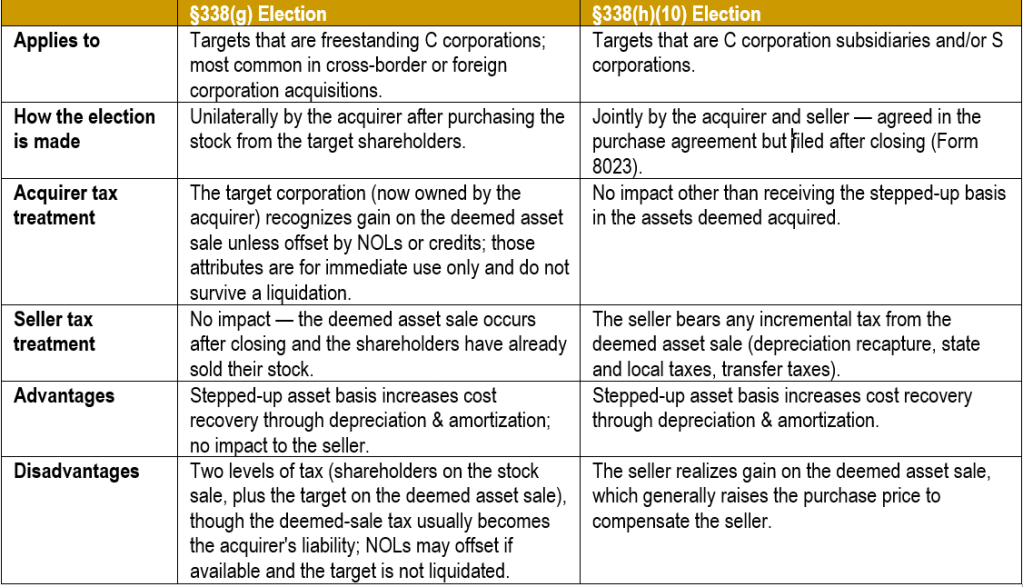
– Cost of the election: the deemed asset sale triggers a corporate-level tax on the $800,000 gain which results in $800,000 × 21% = $168,000, payable up front. This is a second layer of tax: the seller still pays tax on the stock sale, and the election stacks this corporate tax on top, which the buyer effectively funds.
– Benefit (value of depreciating the step-up): $800,000 × 21% = $168,000 of tax savings, but its present value turns on timing. To the extent the step-up is bonus-eligible and deducted in year one under 100% bonus depreciation, the PV approaches the full $168,000. Spread straight-line over a 15-year recovery period (i.e., Goodwill), the PV drops to about $96,000 at an 8% discount rate. In practice only the bonus-eligible portion (tangible personal property and QIP) accelerates; basis allocated to goodwill or other §197 intangibles amortizes over 15 years regardless.
– Bottom line: on these facts the election is roughly breakeven when bonus depreciation applies and value-destructive if the step-up must be recovered slowly . This is why bonus eligibility, and any NOLs available to shelter the deemed gain, often drive the decision. For a domestic standalone C corp that second layer of tax makes §338(g) a hard sell; its more natural home is foreign targets (CFCs), where the deemed gain generally isn’t currently subject to U.S. tax.
§338(g) & NOLs: If Cherry doesn’t elect (plain stock purchase, carryover basis), it inherits Banana’s NOLs going forward, §382-limited. Electing converts the deal to a deemed asset sale, so those carryover NOLs don’t come across, though the target’s own NOLs can first offset the deemed-sale gain, reducing the up-front cost.
338(h)(10): Under §338(h)(10), which applies to targets that are C-corp subsidiaries or S corporations, there’s no separate target final return in the same sense, the deemed-sale gain flows onto the selling consolidated group’s return and the seller’s NOLs shelter it, because the target is deemed to sell-and-liquidate inside the seller’s group.
C. Important Deadlines
Any §338 election must be made by the fifteenth day of the ninth month following the month in which the 80% control (voting and value) of the target was acquired. Once made, the election is irrevocable.
D. Conclusion
Understanding these elections is crucial for both buyers and sellers and, as a result, you should seek professional tax guidance that considers your unique situation before making any tax-related decisions.
Disclaimer: The information provided herein is intended solely for informational purposes and no person(s) or other third-party may rely upon it as financial, tax, or legal advice or use it for any other purposes. As a result, Royal Financial, and any affiliates, assume no responsibility whatsoever to readers, or any other persons for that matter, as a result of the information contained herein.