
Category: M&A – Taxes
-

Start Early: A Business Owner’s Playbook for Keeping More of Your Sale
According to McKinsey, roughly six million (6,000,000) small- and medium-sized American businesses will face an ownership transition over the next decade. Many owners are reaching retirement age while the next generation either isn’t ready or isn’t interested in taking over. Add the artificial-intelligence boom and accelerating consolidation across media, software, manufacturing, and wealth management, and…
-
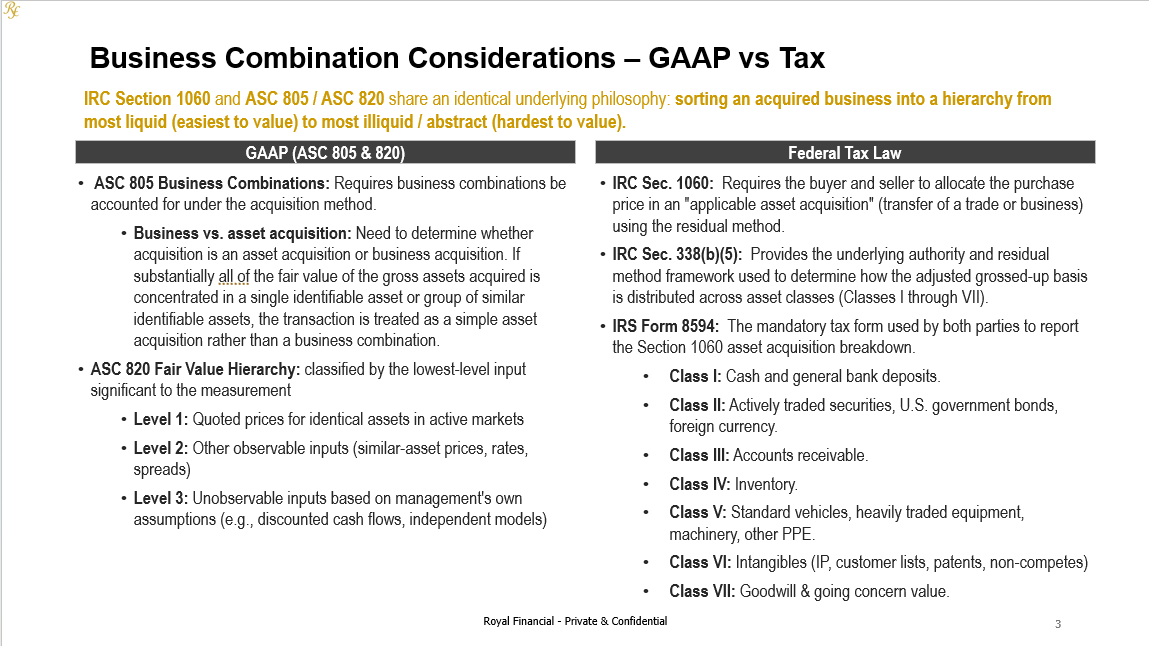
Purchase Price Allocation Differences between GAAP & Tax Reporting
When M&A transactions occur, they typically trigger a purchase price allocation. Working in both Finance and Tax, you realize allocations can vary based on whether they are reported to stakeholders (financial/GAAP reporting) or federal, international, state, and local tax authorities (tax reporting). In this post, we will discuss (1) the purpose of, and key differences…
-

The Skinny on 338 Elections
When it comes to M&A, tax considerations can play a crucial role in negotiating deal terms. Among the various tax elections available, the §338 election is particularly relevant as it allows certain acquirers in a stock sale to mark up the basis of the assets purchased in exchange for increased cost recovery in future periods.…
-
Understanding IRC §409A: Deferred Compensation Rules Every Employer Should Know
Deferred compensation plans are an important tool employers use to attract and retain talent. They allow employees to earn compensation today but receive it later — often at retirement, separation, or another milestone. But with this flexibility comes significant complexity, especially for nonqualified deferred compensation (NQDC) plans. Enter IRC §409A, enacted in 2004 after the…
-
Exit Consideration for Partnerships and S Corporations
Partnerships and S corporations are some of the most widely used tax entities. Although, they are both pass-through entities, these two business structures have significant tax differences. Below we highlight the annual compliance differences between Partnerships and S Corporations. In the next section, we will cover the differences to to consider upon investor exit. #…